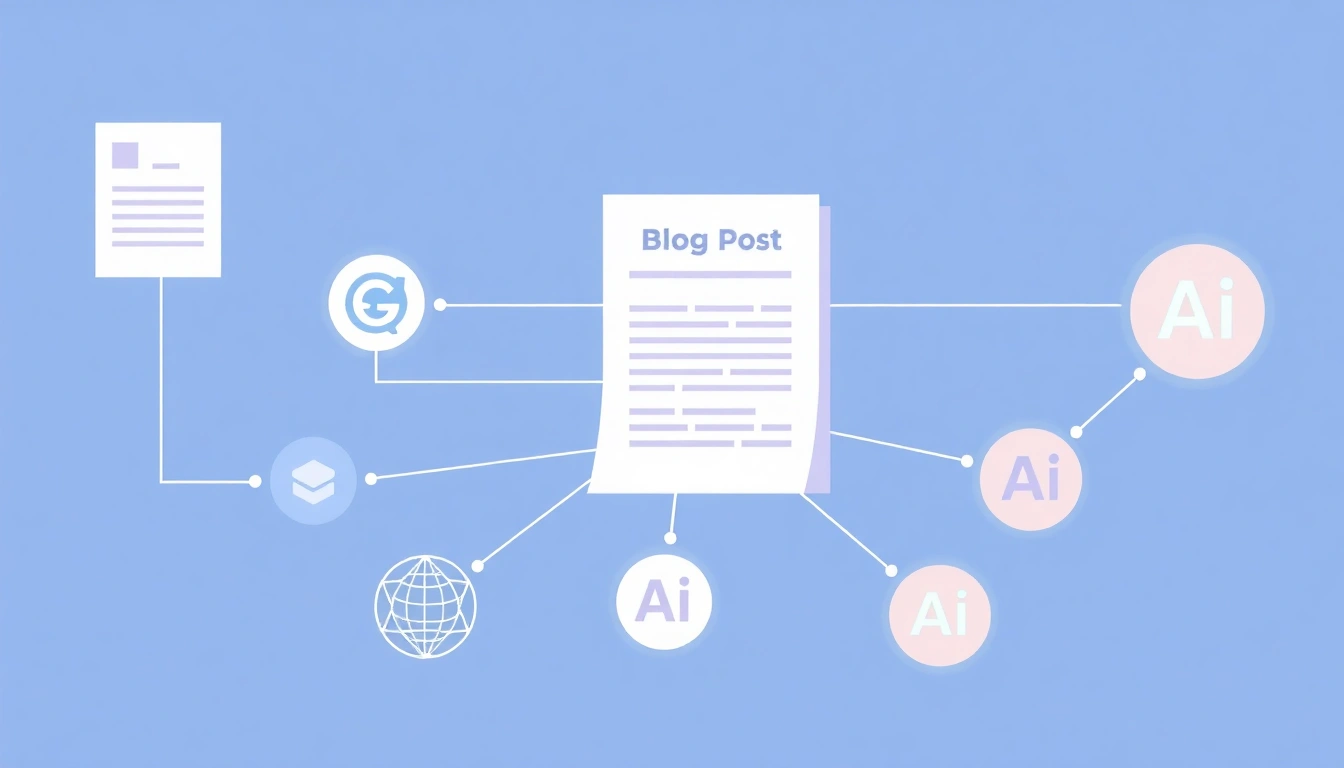
Multimodal content combines text with images, video, charts, or audio in a single published piece. For AI engine citation, visuals alone do not trigger citations. What drives citation is the text structure surrounding those elements: answer-first writing, factual density, and schema markup. Visuals support citation indirectly by improving dwell time and topical authority signals.
What Is Multimodal Content?
Multimodal content integrates two or more content formats within a single published piece. A blog post pairing written analysis with an embedded data chart is multimodal. So is a how-to guide with step-by-step screenshots, or a landing page combining an explainer video with a written transcript. The term carries two meanings: in machine learning, it describes models that process multiple input types simultaneously; in content marketing, it describes publishing formats that span media types within one URL.
For content marketers focused on generative engine optimization, the critical distinction is this: multimodal does not mean substituting visuals for text. It means pairing strong written authority signals with supporting visual elements. AI engines including Google AI Overviews, ChatGPT, Perplexity, and Gemini process text primarily when sourcing citations. Google's multimodal indexing capabilities via Vision AI and video transcripts are expanding, but the citation anchor remains a well-structured text passage. Articles with images get 94% more views than those without visuals (nptechforgood.com), which raises topical engagement signals. Posts with video experience a 4x increase in engagement metrics (nptechforgood.com). Engagement matters to Google's quality assessment, but it does not directly cause AI citation.
How AI Engines Process Non-Text Content Formats
Understanding how AI engines parse non-text elements clarifies exactly where multimodal content helps and where it falls short. Google indexes visual content through image alt text, surrounding paragraph context, descriptive captions, and ImageObject schema markup rather than the raw pixel data of an image. Video is indexed via auto-generated transcripts, title tags, and VideoObject schema, not the video file itself. Perplexity and ChatGPT with browsing retrieve text from HTML. A chart with no descriptive alt text and no accompanying data table is effectively invisible to these engines.
This is why adding descriptive captions and accessible alt text to every visual element is the single highest-leverage multimodal optimization for AI citation purposes. It is not about decoration. A properly marked-up image converts a silent visual into a text signal that AI engines can read, evaluate, and potentially cite. Over 20 billion visual search queries are conducted every month through Google Lens (backlinko.com), which confirms that Google is investing heavily in multimodal processing. But for citation specifically, what Google reads is still the text layer wrapped around those visuals.
Does Multimodal Content Actually Help AI Engines Cite Your Blog?
The direct answer is: not by itself. Pages with clear, factual, well-structured text dominate AI citations. AI Overviews now show up for 21.59% of US search queries on mobile devices, up from 8.61% in 2024 (backlinko.com), and more than 1 billion users worldwide use Google AI Overviews every month (backlinko.com). At that scale, the competition for citation slots is intense. The pages winning those slots are not winning because they have more images. They are winning because their text structure is optimized for extraction.
Consider the citation source distribution. A 2026 analysis found that 83% of AI Overview citations come from pages outside Google's organic top 10 (gogochimp.com). That shift matters: traditional SEO rank is no longer the primary predictor of AI citation. Text-format signals outperform format diversity as citation predictors. Some analyses confirm that text formats far outnumber images in direct citation events. A well-labeled data chart paired with a written interpretation is more citable than the same post with an image that has no alt text or surrounding explanation. The text interpretation is what gets cited. The chart is the credibility amplifier. Adding statistics to content lifted citation likelihood by 25.9% in a 2024 study (answerengineered.com). Unique, original numbers embedded in prose outperform generic visuals because AI engines cite claims, not pictures.
Multimodal elements contribute indirectly through four mechanisms. First, improved dwell time signals topical authority to Google's quality systems. Second, structured data markup helps AI engines parse content type and intent. Third, accessible captions add keyword-rich text that AI engines can read. Fourth, chart data provides citable statistics when paired with written interpretation.
What Content Signals Actually Drive AI Engine Citations
Text-first signals are the primary levers for AI engine citation. Answer-first structure places the core answer within the first 50 to 60 words, creating an extractable passage. Entity density matters significantly: posts with 15 or more specific named entities including institution names, dollar amounts, proper nouns, and metrics are cited at substantially higher rates. Schema-marked pages are cited 2.3x more often than pages without schema markup (everything-pr.com), and sites with complete schema markup see 2.5x higher AI citation rates overall (stackmatix.com).
A February 2026 study by researcher Kurt Fischman analyzed 730 AI citations pulled from ChatGPT and Gemini across 75 commercial queries (everything-pr.com). Pages carrying Product or Review schema with populated fields were cited at 61.7%, versus 41.6% for pages with only generic schema types (everything-pr.com). FAQPage and HowTo schema signal to Google and Bing that content is designed for direct-answer extraction. Factual verifiability, meaning claims tied to named sources like government agencies or peer-reviewed studies, is preferred over generic assertions. Semantic completeness, covering a topic fully within a single self-contained passage, matches how AI engines identify citation candidates. At Heyzeva, we build every post around these text-first citation signals, automating schema markup and answer-first structure so that published content is already optimized without manual formatting.
How to Use Multimodal Elements to Support AI Citation
Multimodal elements earn their place in a GEO strategy when they are implemented with precision, not just presence. Every image needs descriptive alt text that includes the target keyword phrase and describes what the image actually shows. Generic file-name alt text like "image1.jpg" contributes nothing. Specific alt text like "bar chart comparing AI citation rates for schema-marked versus non-schema pages" creates a text signal that AI engines can process and potentially surface. That is the trade-off: effort invested in alt text quality has a measurable citation benefit; effort invested in image aesthetics alone does not.
Charts and data visualizations must always be accompanied by a written summary of the key finding in the body text. Consider a SaaS marketing team embedding a conversion funnel chart in their blog post. If the chart is not accompanied by a sentence like "The data shows a 38% (answerengineered.com) drop-off at the trial activation stage," the AI engine sees only an image. The written interpretation is the citable unit. Video embedded in a post should include a full transcript published as text on the same page. Transcript depth matters more than transcript length: front-load the key claims and named entities in the first 200 words of any transcript, because AI engines weight early content more heavily when evaluating passage relevance. Original data visualizations built from proprietary research or first-party survey data outperform stock images for generative search visibility. Stock images carry no unique information. Original charts carry unique numbers, and unique numbers are more likely to be cited than generic visuals.
Use VideoObject, ImageObject, and FAQPage schema markup to signal multimodal content types to Google's structured data parser. As of March 2026, 31 schema types retain active rich result support in Google Search (digitalapplied.com), giving publishers a broad toolkit. Think of visuals as authority amplifiers. They increase engagement and topical trust signals. But the citation anchor is always a well-structured text passage. Results speak louder. The structure wins.
| Multimodal Element | AI Citation Impact | Key Implementation Requirement |
|---|---|---|
| Image with descriptive alt text | Indirect (adds keyword-rich text) | Target keyword + visual description in alt text |
| Image with no alt text | None | Not readable by AI engines |
| Data chart with written summary | High (text interpretation is citable) | Written key finding in body paragraph |
| Data chart without explanation | None | Chart image is invisible to text parsers |
| Embedded video with transcript | Moderate (transcript is crawlable text) | Full transcript published on same page |
| Embedded video without transcript | None | Video file itself is not parsed for citations |
| Original data visualization | High (unique numbers increase citation probability) | First-party data with source attribution |
| Stock photo | None | No unique information content |
| Schema markup (FAQPage, VideoObject) | High (2.3x citation rate lift) | Populated fields with specific values |
Frequently Asked Questions
Does adding more images to a blog post increase the chances of being cited in Google AI Overviews?
Can AI engines like ChatGPT or Perplexity read charts and infographics?
What is the most important factor for getting a blog post cited by an AI engine?
Does video content on a blog page help with AI engine citation?
Is multimodal content a ranking factor for Generative Engine Optimization (GEO)?
What types of images, videos, or charts are most useful for AI citations?
Does adding structured data improve the chance of being cited by AI engines?
How can I measure whether multimedia increases AI citations?
Do original visuals outperform stock images for generative search visibility?
Should visuals include captions, transcripts, alt text, or source references?
Sources & References
- 2026 Blogging Statistics for Nonprofits | Nonprofit Tech for Good (opens in a new tab)[org]
- How to Rank in Google AI Overviews (2026): The Data-Backed Playbook | GoGoChimp (opens in a new tab)[industry]
- Structured Data AI Search: Schema Markup Guide | Stackmatix (opens in a new tab)[industry]
- Schema Markup After March 2026: Structured Data Update | Digital Applied (opens in a new tab)[industry]
- AI Search Visibility Statistics 2026: Every Verified Number, Sourced | Answer Engineered (opens in a new tab)[industry]
- Google AI Overviews Citation Source Index 2026 | Everything PR (opens in a new tab)[industry]
- 21 Up-To-Date Google Search Statistics for 2026 | Backlinko (opens in a new tab)[industry]
- Schema Markup and AI Citation: What the Research Shows | EPR (opens in a new tab)[industry]
About the Author
Heyzeva
AI visibility content automation platform that creates and publishes content optimized for discovery by generative AI engines like ChatGPT, Perplexity, and Google AI Overviews.
Learn more at heyzeva.com → (opens in a new tab)Related Posts

What Is Source Triangulation and How Do AI Engines Use It to Verify Your Content?
AI engines don't just pick the first result they find. They cross-check facts across multiple independent sources before deciding what to cite. Understanding source triangulation is the first step to making your content visible in AI-generated answers.
8 min readWhat Is Confidence Scoring and How Do AI Engines Use It to Decide Which Sources to Trust?
Confidence scoring is the internal ranking mechanism AI engines use to evaluate how much they trust a source before citing it in a generated answer. Understanding how it works is the first step to getting your content selected. This post breaks down the definition, the key signals, and what it means for your visibility.
7 min read
What Is Freshness Bias? Do AI Engines Prefer Newer Content?
Freshness bias refers to the tendency of AI engines to weight recent content more heavily when selecting sources for generated answers. But recency alone rarely wins citations. Learn how AI engines like ChatGPT and Perplexity actually balance freshness against authority, structure, and factual density.
7 min read