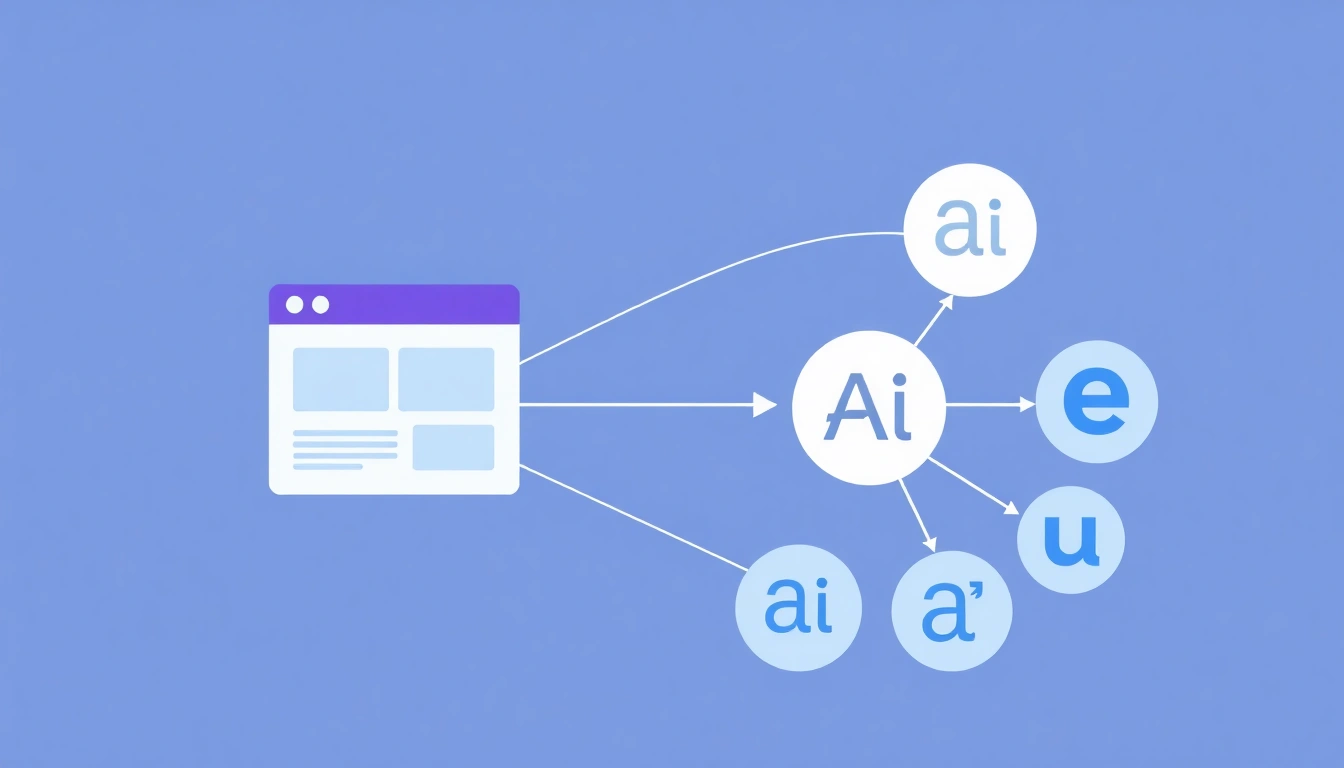
Keyword cannibalization occurs when two or more pages on the same website target the same query, splitting authority and confusing search algorithms. For AI engine citations specifically, it is especially harmful: ChatGPT, Perplexity, and Google AI Overviews need one clear, authoritative page to cite. Fragmented pages rarely get cited.
How Does Keyword Cannibalization Work?
Cannibalization happens when multiple URLs on your site compete for the same target keyword or query intent, sending conflicting signals to crawlers and AI parsers. Search engines and AI indexing systems cannot easily determine which page deserves authority, so they often demote or ignore both pages entirely. The practical result: backlinks, internal links, and topical authority signals are split across multiple pages instead of concentrated on one authoritative source. Generative engine optimization depends on the opposite of this. A single, well-structured page consolidating your best thinking on a topic is what gets cited. Consider a SaaS company that publishes "What is GEO?" in January and then "GEO Explained for Marketers" in June. Both target the same query intent. Neither earns a citation. Even slight title or framing differences do not protect against cannibalization when the underlying query intent is identical. AI citation selection depends on relevance, evidence, clarity, authority, freshness, and the engine's retrieval process, and none of those criteria favor fragmented content.
What Does Cannibalization Look Like in Practice?
In practice, cannibalization is easy to miss because the competing pages look different on the surface. Different titles, different publish dates, different authors. But if the query intent is the same, AI retrieval systems treat them as competing signals. Google Search Console will show multiple URLs ranking for the same keyword cluster. Standard SEO tools can flag the overlap, but they cannot prove that cannibalization caused a specific citation loss. That gap in measurement is important: you are often acting on inference, not direct evidence. A content audit across your blog archive is the most reliable starting point. Filter Google Search Console for queries where more than one URL appears in the impressions data. That is your cannibalization map.
Why Does Keyword Cannibalization Hurt AI Engine Citations Specifically?
AI engines evaluate content at the passage level, not the domain level. They need one clear, structured, self-contained answer to surface and attribute to a source. When authority signals are split across competing pages, no individual passage clears the confidence threshold AI engines use to select citation sources. This is the core mechanism. ChatGPT, Perplexity, and Google AI Overviews all use retrieval-augmented generation (RAG) pipelines. Research on RAG systems shows that context-graph-grounded retrieval can achieve up to 5x improvements in accuracy over raw schemas (atlan.com). That gain disappears when the retrieval system cannot identify a dominant, high-confidence source passage. Repeated or conflicting answers across near-duplicate pages make it harder for the retrieval system to identify the clearest, strongest passage. The engine may select an unintended URL, cite only one of several relevant pages arbitrarily, or return no citation at all. Content scoring above 8.5 out of 10 on semantic completeness is 4.2x more likely to appear in AI Overviews (wellows.com). A consolidated page with a direct opening answer, structured data, and clear entity mentions can reach that threshold. Three fragmented pages on the same topic almost never will.
What Is the Difference Between Traditional SEO Cannibalization and GEO Cannibalization?
Traditional SEO cannibalization hurts rankings by splitting PageRank and anchor text signals across URLs. GEO cannibalization hurts citations by preventing any single passage from reaching the authority threshold AI engines require. The stakes differ significantly. Traditional SEO allows partial recovery through canonical tags and 301 redirects. GEO requires full content consolidation for a citation-ready result. An uncited page gets zero AI-driven discovery traffic. A low-ranked page still earns some organic impressions. That asymmetry matters as AI-driven discovery grows. A 2025 Pew Research Center study of 68,879 searches found that when an AI summary appeared, users clicked a traditional result link in just 8% of visits, versus 15% when there was no summary (seoengico.com). Clicks on a source link inside the summary itself happened in only 1% of visits (seoengico.com). Being cited inside the summary is now the meaningful traffic event. Consolidation does not guarantee more AI citations. A merged page still needs to meet quality thresholds: authoritative citations, specific statistics, and a clear direct answer. Content with authoritative citations earns an 89% higher selection probability in AI Overviews (wellows.com). At Heyzeva, we map each post to exactly one query intent before writing begins. That eliminates cannibalization risk at the production stage, before it can fragment your topical authority.
How to Fix Keyword Cannibalization for AI Citations
Fixing keyword cannibalization for AI engine citations requires a more deliberate approach than the standard SEO playbook. Begin with a content audit. Open Google Search Console, filter for queries where more than one URL appears in impressions data, and document every overlap. That is your cannibalization map. Identify the strongest page for each cannibalized query cluster based on backlinks, word count, structured data, and existing AI citation signals. Consolidate competing pages into one authoritative post using 301 redirects from deprecated URLs to the canonical version. Then restructure the surviving page using GEO content structure best practices: a 40-60 word direct opening answer, declarative H2 headings, and 15 or more named entities throughout. AI Overviews appeared in 13.7% of searches in a 2026 audit (source.washu.edu), meaning competition for those citation slots is intense and growing. Pages ranking first see citation rates of 33.07%, dropping to 13.04% by position ten (maintouch.com). Consolidation raises your odds by concentrating authority. Citing sources alone can improve AI visibility by +40%, adding statistics adds another +37%, and including quotations adds +30% (digitalapplied.com). A consolidated, well-structured page that applies all three methods is a meaningfully different asset than three diluted pages none of which hit those thresholds. Set a content calendar rule going forward: no two posts target the same intent cluster within a rolling 12-month window. That governance rule prevents recurrence. Query intent mapping before writing begins is the structural fix. Measurement remains the hard part. Standard SEO tools flag cannibalization by showing ranking overlap, but they cannot directly attribute a citation loss to a specific cannibalized page pair. Build a parallel tracking system: document which pages you have submitted for indexing, monitor AI citation mentions using brand monitoring tools, and compare citation frequency before and after consolidation. That before-and-after comparison is currently the most reliable way to quantify cannibalization's impact on your AI citation rate.
Frequently Asked Questions
Can keyword cannibalization happen with blog posts that have different titles but similar topics?
Does fixing keyword cannibalization improve my chances of appearing in Google AI Overviews?
How many pages on my site are typically affected by keyword cannibalization?
Is keyword cannibalization worse for GEO than it is for traditional SEO?
What tools can I use to detect keyword cannibalization before it hurts my AI citation rate?
How does keyword cannibalization affect traditional Google rankings?
Can multiple pages targeting one keyword reduce AI engine citations?
How can I detect keyword cannibalization using Google Search Console?
Should I merge, redirect, or differentiate competing pages?
What content structure helps AI engines cite the right page?
Sources & References
- Keyword Cannibalization 2026: AI Citations at Risk | SEO Engico (opens in a new tab)[industry]
- WashU research finds gaps in Google AI Overview citations, claims - The Source - WashU (opens in a new tab)[edu]
- GEO Guide 2026: Generative Engine Optimization Explained (opens in a new tab)[industry]
- What Is RAG? How Retrieval-Augmented Generation Works in 2026 (opens in a new tab)[industry]
- Best GEO Practices November 2026 | Maintouch Guide (opens in a new tab)[industry]
- Google AI Overviews Ranking Factors: 2026 Guide to Winning Citations (opens in a new tab)[industry]
About the Author
Heyzeva
AI visibility content automation platform that creates and publishes content optimized for discovery by generative AI engines like ChatGPT, Perplexity, and Google AI Overviews.
Learn more at heyzeva.com → (opens in a new tab)Related Posts
What Is Query-to-Content Alignment? How AI Engines Match Sources to User Questions
Query-to-content alignment is the degree to which a piece of content directly answers the specific question a user asked an AI engine. Unlike traditional keyword matching, AI engines evaluate structural fit, semantic relevance, and answer completeness before citing a source. Understanding this concept is essential for any brand that wants to show up in AI-generated answers.
7 min read
What Is Cite-Worthiness and How Do AI Engines Decide If Your Blog Earns a Reference?
Cite-worthiness is the measurable quality that determines whether AI engines like ChatGPT, Perplexity, and Google AI Overviews pull your content as a trusted source. Most blogs optimized for traditional SEO fail this test entirely. Here is what actually earns a reference.
7 min read
What Is Temporal Relevance and How Do AI Engines Use It to Decide If Your Content Is Worth Citing?
Temporal relevance is a core signal AI engines use to decide which content is fresh enough to trust and cite. If your content looks outdated, AI systems like ChatGPT, Perplexity, and Google AI Overviews will pass it over for newer sources. This post defines the concept and shows what it means for your content strategy.
8 min read