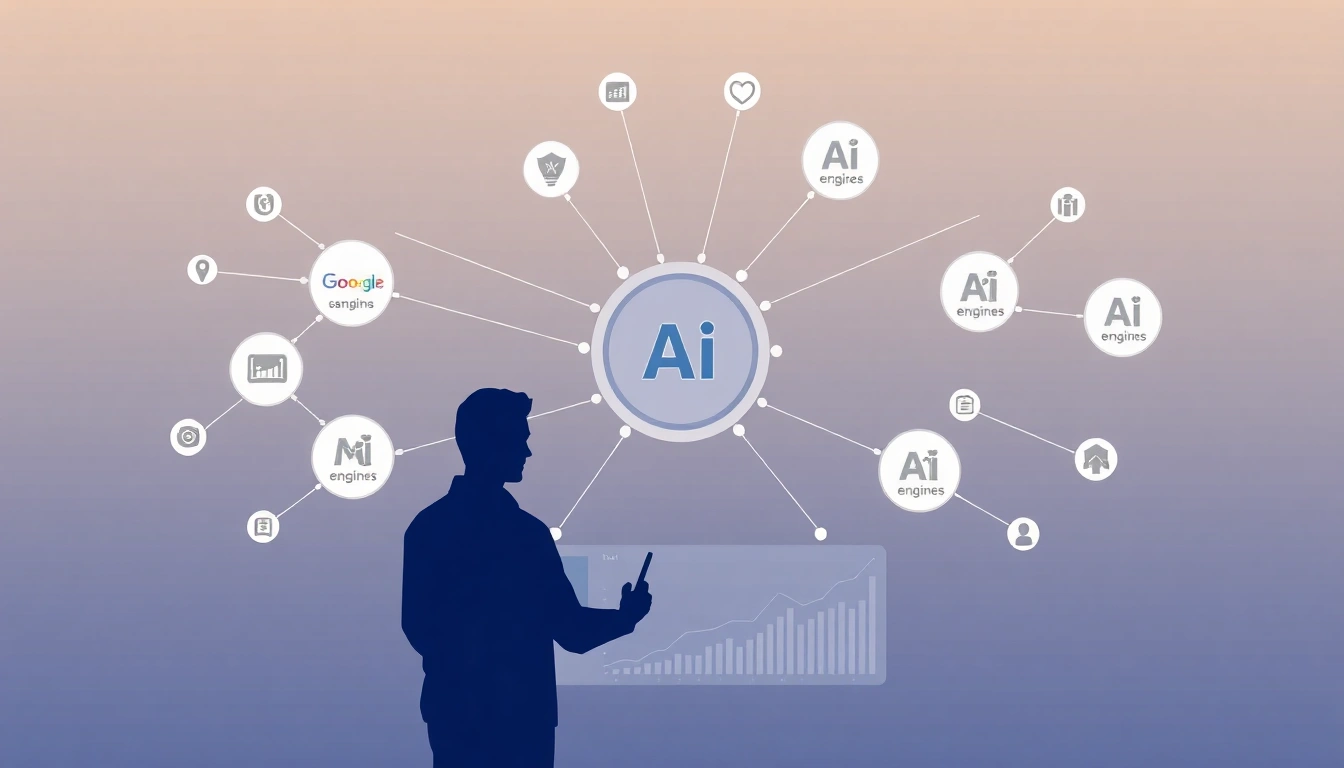
Co-citation occurs when two sources are mentioned together in third-party content without a direct hyperlink between them. AI engines like ChatGPT, Perplexity, and Google AI Overviews use co-citation patterns to infer credibility: if your brand consistently appears alongside recognized authorities, the AI treats your brand as similarly trustworthy and citation-worthy.
How Co-Citation Works in AI Engine Ranking
AI engines do not evaluate sources the same way Google's PageRank algorithm does. Instead of counting hyperlinks, they analyze co-occurrence patterns across millions of web documents, identifying which entities appear together and inferring topical and credibility relationships from that proximity. One study of large language model behavior found that a stable internal link forms in a model's training data once a pair appears together 1,000 to 2,000 times (5wpr.com). That repetition threshold explains why co-citation is not a one-post phenomenon. It compounds. Each independent mention of your brand alongside a recognized authority adds another data point to the pattern AI systems use to classify your brand's credibility tier.
Co-citation also acts as a signal that entities belong to the same topic or category. When a law firm is consistently mentioned in the same paragraphs as the American Bar Association and Martindale-Hubbell, AI engines infer that the firm belongs to a credible cluster of legal authorities. This categorical association is distinct from keyword matching. The AI is not just reading words; it is building an [entity graph](/ what-is-entity-authority-ai-engines-trusted-brand), and your position in that graph determines how frequently you appear in synthesized answers. Research confirms that 92.7% of brands ChatGPT recommended appeared directly on its cited pages (5wpr.com), and a cited brand maintains a recommendation 75% of the time, compared to just 13% for brands missing from cited pages (5wpr.com).
One critical nuance: co-citation is not a universally confirmed single ranking factor with a fixed coefficient, the way domain authority once was in traditional SEO. No AI engine has published an algorithmic specification for co-citation weighting. What researchers have documented is a consistent pattern: brands that appear frequently alongside trusted sources in independent editorial contexts are surfaced more often in AI-generated answers. The mechanism is correlational, not mechanistic, which means practitioners should treat co-citation as a structural content strategy rather than a single metric to optimize.
Co-Citation vs. Traditional Backlinks
Traditional SEO backlinks require a clickable hyperlink to pass authority. Co-citation requires only proximity of mention in text, which fundamentally changes how brands can acquire credibility signals. Google's PageRank algorithm prioritizes hyperlink graphs; AI engines process natural language co-occurrence at scale. A brand mentioned in a Gartner analysis alongside Salesforce gains co-citation equity even if Gartner never links to that brand's website. This distinction matters because only 38% of [AI Overview citations](/ declining-ctr-google-ai-overviews) now come from Google's top-10 organic results, down from roughly 76% just one year prior (turboaudit.ai). The implication is clear: dominating traditional link-building no longer guarantees AI visibility. Co-citation is harder to manufacture than link-building, which makes it a stronger trust signal for AI systems trained to detect authenticity.
Weak or low-quality co-citation carries real risk, and this is the part most glossary posts skip. If your brand repeatedly appears alongside low-authority or contextually irrelevant sources, AI engines can associate you with a less-trusted cluster. A SaaS company mentioned alongside spammy affiliate blogs or content-farm roundups accumulates negative co-citation pressure, not positive equity. The entity graph pulls in both directions. Brands have more to lose from careless co-citation than from no co-citation at all, because the AI's clustering logic is largely automated and non-negotiable.
Why Co-Citation Matters for AI Engine Visibility
The stakes for AI engine visibility are now measurable and significant. A total of 94% of B2B buyers used AI during their most recent purchase process, with 55% using it to compare vendors and 47% using it to build internal business cases before any vendor contact (machinerelations.ai). Buyers are making shortlists inside AI engines before they visit a single vendor website. Brands that accumulate co-citation equity across independent publications are statistically more likely to be named in those AI-generated answers. Brands named inside an AI Overview receive 35% more organic clicks than they would otherwise (transference.studio). Visibility is now binary in a way it never was with organic search.
The variance in co-citation signal strength across AI engines is significant and underreported. Perplexity cites a median of 6.4 unique domains per answer, while Claude cites 3.6, ChatGPT 3.1, and Gemini only 2.4 (attrifast.com). ChatGPT averages 15 citations per response while Gemini averages only 3 (turboaudit.ai). These are not cosmetic differences. A brand targeting Perplexity visibility needs broader co-citation distribution across more domains. A brand targeting Gemini needs deeper co-citation with a smaller number of highly authoritative sources. Treating all AI engines generically is a strategic error.
Measurement is the gap most content strategies ignore. At Heyzeva, we track co-citation impact by monitoring brand mention frequency in AI-generated answers across engines over rolling 30-day windows, comparing answer rate before and after new content publication. This is distinct from rank tracking. You are measuring entity surface frequency, not keyword position. A study of 22.7 million citations across five models found that 79.6% of cited sources appeared in only one model (5wpr.com), which confirms that cross-engine co-citation coverage requires deliberate, multi-platform content strategy, not a single publication.
Content Formats That Generate the Strongest Co-Citation Signals
Not all content types build co-citation equity equally. Editorial reviews collectively captured 22.3% of all AI citation slots across engines in 2026 (attrifast.com), making them the most productive format for co-citation accumulation. Definition and glossary posts that cite multiple recognized sources in a single passage build co-citation density efficiently because they document entity proximity explicitly. Roundup and comparison posts that name your brand alongside category leaders create high-value co-occurrence patterns at scale. Structured, answer-first content is more likely to be re-quoted by other publications, creating downstream co-citation across independent domains. Research confirms that 40 to 60 word answer capsules achieve a 72.4% single-feature citation rate in AI Overviews (turboaudit.ai). Structure is not cosmetic. It is the mechanism.
How to Build Co-Citation Authority for Your Brand
Building co-citation authority requires a deliberate content architecture, not just a publishing schedule. The actionable framework has four structural components that compound over time.
First, publish content that explicitly references and engages with recognized authorities in your industry. This creates documented co-occurrence between your brand and those sources in the same editorial context. A dental practice writing about oral cancer screening should cite the American Dental Association and the National Institutes of Health in the same article where the practice name appears. For example, imagine a solo dentist in Austin publishing a post on early signs of oral cancer that mentions both the ADA's clinical guidelines and recent NIH research in the same sections where the practice name and the dentist's credentials appear. That single article becomes a co-citation data point linking the practice to established health authorities, and when repeated across 15-20 posts over six months, the AI's entity graph begins classifying the practice as part of a credible dental authority cluster rather than an isolated local business. That article then becomes a co-citation data point that AI engines ingest. The practice name and the ADA now share an editorial context. Repeat that pattern across 20 articles, and the AI's entity graph starts classifying the practice as part of a credible dental authority cluster.
Second, contribute to third-party publications, podcasts, and research reports where your brand name appears alongside established players in the same editorial segment. Query language accounted for 26.5% of variance in LLM brand recommendations across a study of 12,933 responses (5wpr.com), which means your brand needs to appear in the natural language contexts where buyers ask questions, not just the contexts where you publish.
Third, use structured data and named entities consistently across all content. AI engines track specific brand names, publication names, and named experts as discrete entities. Generic keyword stuffing produces zero co-citation value. Precision matters.
Fourth, prioritize content formats with high re-citation rates: original research, statistics roundups, expert commentary, and precise definitions. Citation density across AI engines grew 28% year-over-year from May 2025 to May 2026 (attrifast.com), meaning the competition for citation slots is accelerating. Publishing formats that attract downstream citations from other authors compounds your co-citation equity without additional effort.
Heyzeva automates the structural elements of co-citation-optimized content, including entity placement, citation formatting, and answer-first passage architecture, so every published post contributes to compounding AI engine trust. For a SaaS company targeting Perplexity visibility specifically, this means each post is engineered to appear across the 6.4-domain citation spread that Perplexity averages per answer, not just optimized for a single query.
| Content Format | Co-Citation Strength | Primary AI Engine Benefit | Re-Citation Potential |
|---|---|---|---|
| Definition / Glossary Post | High | All engines (entity density) | High |
| Original Research / Statistics | Very High | Perplexity, ChatGPT | Very High |
| Expert Roundup | High | ChatGPT, Claude | Medium |
| Comparison / Review Post | High | All engines (editorial slot) | Medium |
| Generic Blog Post (no citations) | Low | Minimal | Low |
| Spammy Roundup | Negative | Negative cluster association | None |
Frequently Asked Questions
How is co-citation different from backlinks?
Can co-citation improve AI search rankings?
How do AI engines measure co-citation trust signals?
What are examples of strong co-citation in SEO?
How can I build co-citation for my brand?
Is co-citation the same as brand mentions in SEO?
How long does it take for co-citation signals to influence AI engine citations?
Can a small or new brand build co-citation authority, or is it only for established companies?
Does co-citation work differently across ChatGPT, Perplexity, and Google AI Overviews?
What is the difference between co-citation and co-occurrence in AI engine optimization?
Sources & References
- AI Citation Rates by Industry 2026 (Study) | Attrifast[industry]
- 94% of B2B Buyers Use AI for Vendor Research | Machine Relations[industry]
- AI Search Ranking Factors 2026: Evidence Audit | TurboAudit[industry]
- Co-Occurrence in LLMs: How AI Links Brands | 5WPR[industry]
- Backlink Statistics: 17 Critical, Effective AI Citation Insights | Transference Studio[industry]
About the Author
Heyzeva
AI visibility content automation platform that creates and publishes content optimized for discovery by generative AI engines like ChatGPT, Perplexity, and Google AI Overviews.
Learn more at heyzeva.com →Related Posts

What Is Contextual Relevance Scoring and How Do AI Engines Use It to Pick Sources?
Contextual relevance scoring is the multi-signal process AI engines use to evaluate whether a piece of content is the most accurate, authoritative, and structurally appropriate source to cite in a generated answer. Understanding it is the foundation of Generative Engine Optimization (GEO). This post defines the concept, explains how the scoring works, and shows why it matters for your content strategy.
What Is Passage Indexing and How Does It Help AI Engines Cite Specific Sections of Your Blog?
Passage indexing lets search and AI engines rank or cite individual paragraphs from a page, not just the page as a whole. Understanding how it works is the foundation of any serious Generative Engine Optimization strategy. Here is what every marketer needs to know.

What Is Prompt Grounding and How Does It Determine Which Sources AI Engines Cite?
Prompt grounding is the mechanism AI engines use to tie their generated answers to specific, verifiable external sources rather than relying on training data alone. Understanding it is the first step to getting your content cited. This post explains exactly what prompt grounding is and why it determines which brands appear in AI-generated answers.